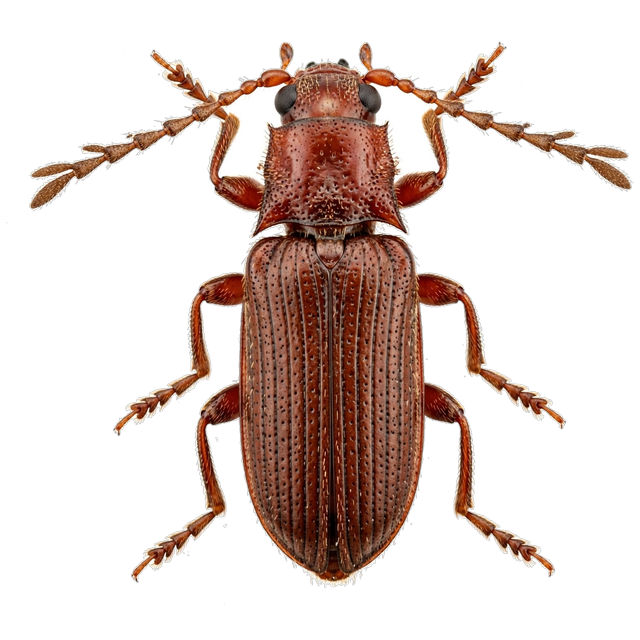
 Confused flour beetle
Tribolium confusum (Jacquelin du Val, 1868)
Confused flour beetle
Nearly identical to the red flour beetle, but it can't fly and prefers cooler pantries, the exam loves this pair.
- Order
- Coleoptera
- Family
- Tenebrionidae
- Group
- Stored-product beetles
- Ontario status
- Established, cosmopolitan in Ontario; the dominant Tribolium in cooler indoor environments
Why it matters
The temperate counterpart to the red flour beetle and the more common of the two in Ontario homes. The pair is a classic exam identification question.
Origin
African in origin; spread worldwide with the grain trade centuries ago.
Behavior
Cannot fly, so it walks between products. Otherwise identical habits: year-round activity indoors, both larvae and adults feeding.
Living conditions
Same pantry universe as the red flour beetle, flour, cereal, pet food, grain dust in cracks. Tolerates cooler conditions better, which is why it dominates in temperate homes.
Signs of presence
- Small reddish beetles in flour that never take flight when disturbed
- Mustiness and discoloration in infested flour
Weaknesses
- Flightless, spreads only by walking or in contaminated product
- Killed by freezing
- Cannot use whole kernels; depends on milled product and residues
Myths and facts
Myth The two flour beetles need different treatment.
Reality For homeowners the response is identical, find and discard the infested product. The species distinction matters for professionals monitoring mills and for the exam.
Research notes
Morphology
3-4 mm, reddish-brown. Antennae thicken gradually toward the tip (no abrupt club). Eyes widely separated beneath (about 2+ eye-widths apart). Flightless, elytra present but hind wings reduced.
Diagnostics
Gradual antennal club + wide eye separation + flightlessness = confused flour beetle. Best confirmed side-by-side with T. castaneum.
Easily confused with
- Red flour beetle, Tribolium castaneum Confused: gradual antennal club, eyes widely separated beneath, cannot fly. Red: abrupt 3-segmented club, eyes nearly touching, flies.
Life cycle
- Adult
- Live a year or more; continuous reproduction in warmth
- Egg
- Laid in flour; hatch in ~1-2 weeks depending on temperature
- Egg to adult
- 6-10 weeks at 25 °C; slower in cool pantries
- Generations per year
- 3-5 indoors
- Nymph or larva
- Cylindrical larvae feed 3-6 weeks
Development
Complete metamorphosis: egg → larva → pupa → adult.
Reproduction
~200-400 eggs per female lifetime.
Distribution
- Global
- Cosmopolitan; dominant in temperate regions
- Native range
- Africa
- Ontario
- Established; the more cold-tolerant Tribolium, common in homes and cool storage
Ecology
Cooler-temperature tolerance gives it the edge over T. castaneum in temperate storage; same benzoquinone defensive chemistry and aggregation pheromones.
Resistance
Phosphine resistance documented but generally less intense than in T. castaneum; monitored in the grain trade.
IPM implications
Same sanitation-first logic as the red flour beetle, with one practical difference: flightlessness means infestations stay local, find the source product and the problem is contained. In mills, species ID informs which resistance profile to expect.
Chemical ecology
Aggregation pheromones analogous to T. castaneum; benzoquinone defensive secretions.
Genetics and DNA
No reference genome published as of 2026 (studied comparatively against the T. castaneum genome).
Taxonomy
Order Coleoptera, family Tenebrionidae. The 'confused' in the name refers to its long confusion with T. castaneum, the pair was only reliably separated by 19th-century entomologists.
Open questions
Competitive displacement dynamics between the two Tribolium species across temperature gradients in modern climate-controlled storage.
References
- Hagstrum, D.W. & Subramanyam, B. (2006). Fundamentals of Stored-Product Entomology. AACC International.