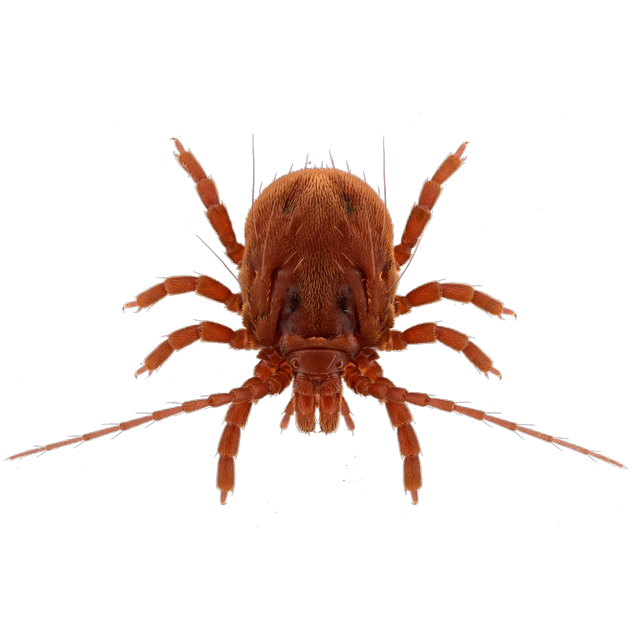
 Clover mite
Bryobia praetiosa Koch, 1836
Clover mite
The tiny red dots marching across your sunny windowsill in spring, they don't bite, they just visit in armies.
- Order
- Trombidiformes
- Family
- Tetranychidae
- Group
- Ticks & mites
- Ontario status
- Established, common spring/fall invader across Ontario
Why it matters
It matters only as a nuisance, thousands of harmless dots on the windowsill. The red stain when crushed is the worst of it. The real fix is outside: trim the lawn back from the walls and seal the gaps they walk through.
Origin
Europe originally; now wherever there are lawns pressed against house foundations.
Behavior
Feeds on lawn grasses, then marches up sunny walls in enormous numbers on warm spring and fall days. Comes indoors through tiny gaps around windows and foundations.
Living conditions
Lawns, clover patches, and the sunny south and west walls of houses. Indoors: windowsills, curtains, and walls near entry points.
Signs of presence
- Masses of tiny reddish dots moving on sunny exterior walls in spring or fall
- Mites on interior windowsills on warm afternoons
- Reddish smears where mites were crushed on light fabrics or walls
- A green lawn growing right up to the foundation
Weaknesses
- Cannot bite, cannot damage homes, it has no way to harm you
- Desiccates indoors within days without plant food
- Completely blocked by sealed cracks and a vegetation-free strip around the foundation
- Vulnerable to a vacuum cleaner, the entire indoor population can be removed in minutes
Myths and facts
Myth The tiny red bugs are biting me / sucking blood.
Reality Clover mites cannot bite, their mouthparts are built for piercing plant cells, not skin. The red color is just their body pigment, not your blood.
Research notes
Morphology
0.75-1.0 mm; reddish-brown to olive; the front pair of legs is strikingly long (often mistaken for antennae). Eight legs; soft-bodied; crushes to a red stain.
Diagnostics
Reddish-brown mite ~1 mm with conspicuously long front legs, in large numbers on sunny building exteriors and windowsills, spring or fall. Non-biting. Plant-feeding confirmed by context.
Easily confused with
- Spider mites (Tetranychus spp.) Spider mites are smaller, web-spinning, and stay on plants; clover mites are larger, long-legged, and march on buildings.
- Bird mite (Ornithonyssus spp.) Bird mites bite and are associated with nests; clover mites never bite and gather on sunny walls.
Life cycle
- Adult
- Adults overwinter in wall voids and emerge on warm spring days
- Egg
- Eggs laid in turf and bark crevices; overwintering stage
- Egg to adult
- About 1 month in warm weather
- Generations per year
- Several, overlapping
- Nymph or larva
- Larva six-legged, then two nymphal stages; all feed on plants
Development
Egg to larva to nymphs to adult; parthenogenetic, populations are effectively clonal. Overwinters as eggs in turf and as adults in wall voids.
Reproduction
Thelytokous parthenogenesis, all individuals are female and every one lays viable eggs. A single mite on a wall can found next spring's invasion.
Distribution
- Global
- Temperate regions worldwide
- Native range
- Europe (introduced to North America)
- Ontario
- Common province-wide wherever lawns meet foundations
Ecology
Feeds on grasses, clover, and ornamental plants; uses buildings as overwintering and basking sites. Population eruptions follow lush lawn growth. Entirely harmless to structures and people, a pure nuisance species.
Resistance
Unknown, managed physically; no documented resistance.
IPM implications
A textbook exclusion case: seal foundation cracks and window frames, maintain a vegetation-free gravel barrier (30-60 cm) around the foundation, and keep grass trimmed back from walls. Indoors, vacuum only, crushing stains fabrics red. Chemical treatment is disproportionate and usually ineffective against the outdoor reservoir.
Chemical ecology
Phytophagous, feeds on plant cell contents, not blood; no venom, no saliva of medical relevance. All-female parthenogenetic reproduction (males unknown/rare) enables explosive population growth from a single founder.
Genetics and DNA
No reference genome published as of 2026.
Taxonomy
Order Trombidiformes, family Tetranychidae (spider mite family). Authority Koch, 1836. Despite the family, it does not spin webbing the way spider mites do.
Open questions
Exact overwintering physiology; why some buildings are hit year after year while neighbors are spared.
References
- Krantz, G.W. & Walter, D.E. (2009). A Manual of Acarology, 3rd ed., Texas Tech University Press.
- Ebeling, W. (1978). Urban Entomology, University of California, Riverside.