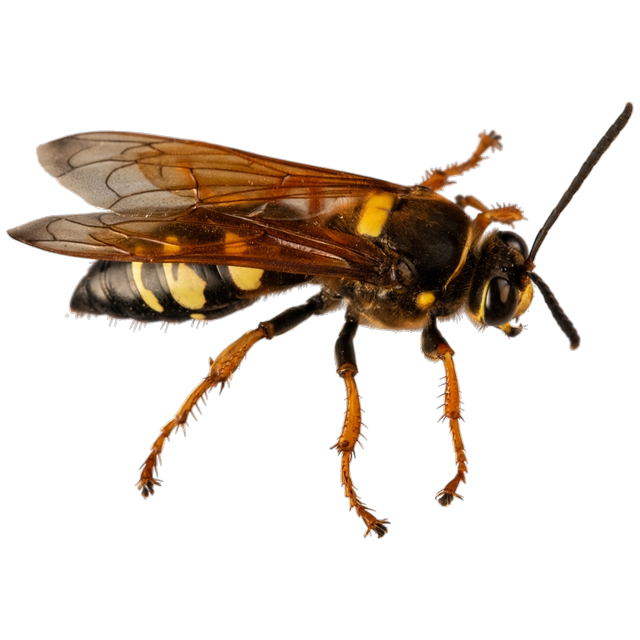
 Cicada killer wasp
Sphecius speciosus (Drury, 1773)
Cicada killer wasp
A huge black-and-yellow wasp that hunts cicadas; rarely stings people.
- Order
- Hymenoptera
- Family
- Crabronidae
- Group
- Wasps, hornets & bees
- Ontario status
- Present in southern Ontario, common digger wasp across the eastern US
Why it matters
Looks terrifying, acts harmlessly, the single most misunderstood wasp in Ontario. Females reserve their sting for cicadas and sting people only if grabbed; males cannot sting, period. The complaint is burrow mounds in lawns and fear, not stings.
Origin
Native to eastern North America, a long-standing Ontarian, doing exactly what its name says every summer.
Behavior
Solitary, each female digs her own burrow, then hunts cicadas one by one, paralyzing each with a sting and dragging it underground as living food for one larva. Males patrol territories and grapple intruders but cannot sting at all. Active July, August.
Living conditions
Sunny, sandy, well-drained soil for burrowing: lawn edges, gardens, playgrounds, and bare patches. Needs annual cicadas nearby as prey, where cicadas sing, cicada killers dig.
Signs of presence
- U-shaped mounds of excavated sand ~10 cm across on lawns and paths in midsummer
- Huge wasps hovering low over lawns, carrying cicadas in flight
- Burrow entrances ~15 mm wide in bare sandy patches
- Males dogfighting in the air over territories, noisy but harmless
Weaknesses
- One generation per year, the whole season is a few summer weeks
- Needs bare sandy soil; thick turf and mulch block burrowing
- Each burrow provisions only a handful of cells, low reproductive output per female
- Males are all bluff: no stinger, no venom, just grappling
Myths and facts
Myth They're aggressive and will chase you.
Reality Males chase each other, not people, and they can't sting. Females are too busy hunting cicadas to care about you.
Myth A big wasp means a dangerous wasp.
Reality Size and danger are unrelated here. This is a solitary hunter, not a colony defender, it has no nest full of sisters to protect, which is why it doesn't attack.
Research notes
Morphology
Females 30-50 mm, males 25-35 mm, among the largest wasps in Ontario. Black abdomen with yellow bands, reddish-brown thorax, amber wings. Females have a functional stinger (modified ovipositor); males lack one entirely.
Diagnostics
Confirm by: very large size + reddish thorax + yellow-banded black abdomen + sandy burrow mounds in midsummer. European hornets are social, nest in cavities, and lack the burrow-mound association.
Easily confused with
- European hornet, Vespa crabro European hornet is social (colony, paper nest in cavities) and active at dusk; the cicada killer is solitary, nests in ground burrows, and active by day.
Life cycle
- Egg
- Single egg laid on a paralyzed cicada sealed in an underground cell
- Nymph or larva
- Larva consumes the living-but-paralyzed cicada over ~2 weeks, then spins a cocoon
- Adult
- Lives 2-4 weeks in the midsummer; males emerge first and patrol
- Egg to adult
- ~11 months including overwintering as a prepupa in the soil
- Generations per year
- 1 per year
Development
Complete metamorphosis: egg → larva (feeding on the paralyzed cicada) → pupa (overwintering in a soil cocoon) → adult.
Reproduction
Each female provisions ~6-15 cells per burrow, one cicada (male offspring) or 2-3 cicadas (female offspring) per cell, prey number sets the sex of the offspring.
Distribution
- Native range
- Eastern North America
- Ontario
- Present in southern Ontario; common where sandy soils meet cicada populations
- Global
- Eastern North America; related Sphecius species across the Americas
Ecology
Obligate cicada predator; females paralyze (not kill) prey with venom, preserving it fresh for the larva. Males hold small mating territories and grapple rivals mid-air. Adults feed on nectar. Peak activity tracks annual cicada emergence.
Resistance
Unknown, not a pesticide target species.
IPM implications
First-line response is education: the risk profile does not justify intervention in nearly all cases. Monitoring: midsummer burrow-mound mapping. Lawns are made unattractive by thick turf and mulch over sandy patches; burrows in high-traffic areas are best tolerated for the few weeks of activity. No colony exists to 'remove', each burrow is one female's work.
Chemical ecology
Venom is a prey-paralysis formulation tuned to cicada nervous systems, defensive use against vertebrates is essentially absent. Males mark territories; cuticular hydrocarbons mediate mate recognition.
Genetics and DNA
No reference genome published as of 2026.
Taxonomy
Hymenoptera: Crabronidae. Sphecius speciosus (Drury, 1773), a solitary digger wasp, not a social wasp; the 'killer' hunts cicadas, not people.
Open questions
Venom composition specificity across cicada prey species; range dynamics at the northern edge in Ontario.
References
- Evans, H.E. (1966) The Comparative Ethology and Evolution of the Sand Wasps, Harvard Univ. Press
- BugGuide.net, Sphecius speciosus species account