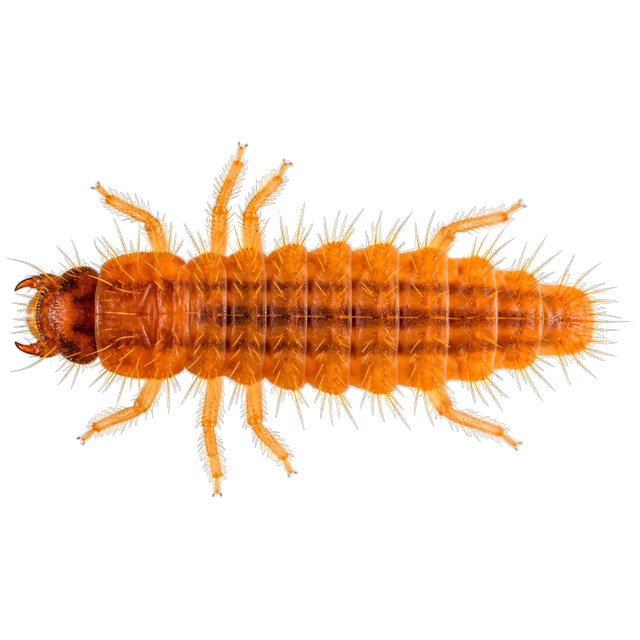
 Chigger
Trombiculidae
Chigger
The itchy red welts from the tall grass, caused by a baby mite that doesn't burrow, despite the legend.
- Order
- Trombidiformes
- Family
- Trombiculidae
- Group
- Ticks & mites
- Ontario status
- Present in parts of Ontario, minor outdoor nuisance; reference entry
Why it matters
Chiggers cause some of the itchiest bites in nature, but they are a minor Ontario concern, a cottage-country and tall-grass nuisance, not a home infestation. Knowing they don't burrow saves people from harmful home remedies.
Origin
Worldwide, wherever there is warm-season tall grass.
Behavior
The microscopic baby mite climbs grass, grabs your ankle, and injects digestive enzymes, then drops off after a few days. The maddening itch that follows is your body's reaction, peaking after the mite is long gone.
Living conditions
Tall grass, brushy field edges, berry patches, and unkempt lawns. Not in homes, not in beds.
Signs of presence
- Clusters of intensely itchy red welts around sock lines, waistbands, and other tight clothing edges
- Welts appearing 24-48 hours after walking through tall grass or brush
- Tiny orange specks visible on skin or clothing during exposure
- Seasonal pattern: warm months, grassy habitats
Weaknesses
- Feeds only as a larva, one brief parasitic stage in an otherwise free-living life
- Cannot survive indoors or on the body long-term; drops off on its own
- Blocked by closed shoes, long trousers tucked into socks, and showering after exposure
- Needs tall grass and humidity, mowed sunny ground is safe ground
Myths and facts
Myth Chiggers burrow under your skin and lay eggs.
Reality They do neither. The larva feeds from the surface through a hardened feeding tube, then drops off. Nothing is living under your skin, the itch is an immune reaction to the saliva left behind.
Myth Clear nail polish suffocates the chiggers in your skin.
Reality There is nothing to suffocate, the mites left days ago. The polish only irritates already-inflamed skin.
Research notes
Morphology
Larva 0.2-0.4 mm, orange-red, six legs, the only stage people meet. Adults ~1 mm, eight-legged, velvety red soil predators.
Diagnostics
Clusters of intensely itchy red welts at clothing constriction lines (socks, waistband) after grassy outdoor exposure. The larvae are 0.2-0.4 mm and usually gone by the time the itch peaks.
Easily confused with
- Clover mite (Bryobia praetiosa) Clover mites are plant feeders that never bite; chigger welts come from grassy outdoor exposure with intense itching.
Life cycle
- Adult
- Free-living predators in soil; females lay eggs in soil
- Egg
- Eggs laid in soil in summer
- Egg to adult
- About 2 months in warm conditions
- Generations per year
- One to several depending on climate
- Nymph or larva
- The six-legged larva quests, attaches, feeds for days, drops off, and molts into a predatory nymph
Development
Egg to parasitic six-legged larva to free-living eight-legged nymph to adult. The infamous stage is the only parasitic one; the rest of the life is a soil predator.
Reproduction
Females lay eggs singly in soil; larvae hatch and quest. No host is needed for the population, humans are incidental.
Distribution
- Global
- Worldwide, most diverse in tropics and subtropics
- Native range
- Worldwide
- Ontario
- Present in some southern Ontario habitats; a minor and patchy nuisance compared to the U.S. Southeast and Midwest
Ecology
Larvae quest on low vegetation like ticks; nymphs and adults are beneficial soil predators of small arthropods and eggs. Habitat: tall grass, brushy edges, berry patches.
Resistance
Not applicable, not a pesticide target.
IPM implications
Personal protection and habitat management only: keep grass short in recreation areas, wear treated clothing outdoors (per label, a licensed-operator or label-following activity), shower after exposure. No structural program exists or is needed.
Chemical ecology
Larval saliva contains digestive enzymes that liquefy skin cells; the feeding tube (stylostome) hardens in the skin and the immune reaction to it causes the itch. Only the larval stage is parasitic, nymphs and adults are free-living predators.
Genetics and DNA
No reference genome published as of 2026.
Taxonomy
Order Trombidiformes, family Trombiculidae. A large family of velvet mites and chiggers; only the larval 'chigger' stage is parasitic.
Open questions
Ontario distribution mapping is sparse; species-level identification of biting populations rarely done.
References
- Krantz, G.W. & Walter, D.E. (2009). A Manual of Acarology, 3rd ed., Texas Tech University Press.