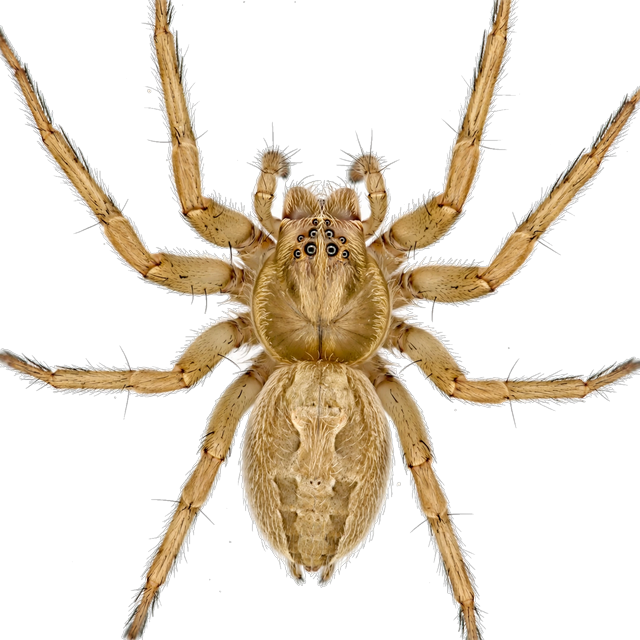
 Brown recluse
Loxosceles reclusa (Gertsch & Mulaik, 1940)
Brown recluse
The spider everyone fears and almost no one in Ontario has ever actually seen.
- Order
- Araneae
- Family
- Sicariidae
- Group
- Spiders
- Ontario status
- NOT established, myth-buster dossier; occasional intercepted specimens only
Why it matters
It matters because of the damage the myth does: thousands of skin lesions across North America are blamed on a spider that was never there, delaying real diagnoses, staph and MRSA infections, diabetic ulcers, vasculitis. Knowing what is NOT in Ontario is public-health work.
Origin
The south-central United States, its real range is roughly Kansas to Texas to the lower Midwest. Ontario is far outside it.
Behavior
True to its name, reclusive, nocturnal, non-aggressive. Bites only when trapped against skin in clothing or bedding.
Living conditions
In its home range: undisturbed indoor clutter, closets, attics, woodpiles. In Ontario: essentially nowhere, it cannot establish breeding populations in our climate.
Signs of presence
- In Ontario: none reliably. Reports without a captured specimen are not evidence.
- A spider with exactly six eyes in three pairs (needs magnification to check)
- Irregular webs in undisturbed clutter (in its actual range)
Weaknesses
- Cannot survive Ontario winters outdoors or establish indoors here
- Every 'recluse' found in Ontario has been a misidentification or a lone hitchhiker
- Non-aggressive; even in its home range, bites are uncommon
- Easily distinguished by its six eyes, if it has eight eyes, it is not a recluse
Myths and facts
Myth Brown recluses infest Ontario homes.
Reality Not established in Ontario, virtually all 'recluse bites' here are misdiagnosed skin conditions or other spiders. Arachnologists use a rule of thumb: no confirmed specimen, no recluse.
Myth You can identify a recluse by the violin marking on its back.
Reality Many harmless spiders have violin-like marks, and some recluses barely show one. The reliable character is the six-eye arrangement, three pairs, which needs magnification to see.
Research notes
Morphology
Body 6-12 mm; uniform tan to brown; the definitive character is six eyes in three dyads (most spiders have eight). Long thin legs; no spines. The 'violin' marking is unreliable and should never be the sole criterion.
Diagnostics
Six eyes in three pairs, confirmed under magnification, plus range plausibility. In Ontario, range alone rules it out, demand a voucher specimen for any claim, and expect it to key to something else.
Easily confused with
- Spitting spiders (Scytodes thoracica) Also six-eyed, but with a strongly domed carapace and much shorter legs; common and harmless in Ontario.
- Woodlouse hunter (Dysdera crocata) Eight eyes, massive forward-projecting jaws, reddish carapace, a completely different spider often called a recluse by mistake.
Life cycle
- Adult
- Adults live 1-2+ years
- Egg
- 30-50 eggs per sac; female guards the sac
- Egg to adult
- Up to a year in temperate conditions
- Generations per year
- One in its native range
- Nymph or larva
- Slow development; spiderlings resemble pale adults
Development
Egg to spiderling to adult through successive molts. Remarkably long-lived for a spider: adults can survive 2+ years, and months without food or water.
Reproduction
Males wander to find females; females produce several sacs per season. Low dispersal ability, populations are highly localized, which is one reason it has not spread to Ontario.
Distribution
- Global
- North American endemic; congeners (including the medically significant L. laeta) in South America and the Mediterranean
- Native range
- South-central United States
- Ontario
- Not established; occasional intercepted specimens only. No breeding populations documented.
Ecology
In its native range, a synanthropic predator of small arthropods in undisturbed microhabitats. Its limited dispersal and cold intolerance define its range boundary well south of Ontario.
Resistance
Unknown, no documented resistance of note.
IPM implications
None in Ontario beyond identification and reassurance. The professional protocol for any 'recluse' report: collect the specimen, examine the eyes, document the finding, and use the moment to educate, including referring suspected bite lesions to medical care, since the real causes (bacterial infection, etc.) need treatment the spider story delays.
Chemical ecology
Venom contains sphingomyelinase D, the enzyme behind dermonecrotic loxoscelism in a minority of verified bites. The biochemistry is real; the epidemiology in Ontario is not, venom chemistry does not create spiders where none live.
Genetics and DNA
A draft whole-genome assembly for L. reclusa is published (3.26 Gb, NCBI GCA_001188405.1; listed in arachnid genomics reviews), a draft, not chromosome-level.
Taxonomy
Order Araneae, family Sicariidae. Authority (Gertsch & Mulaik, 1940). The only Loxosceles of medical note in North America; Ontario has no established sicariids.
Open questions
Why range expansion has stalled despite climate warming; true bite incidence even within the native range is overestimated by orders of magnitude.
References
- Foelix, R.F. (2011). Biology of Spiders, 3rd ed., Oxford University Press.
- Vetter, R.S., UC Riverside spider-bite myth research (various publications).