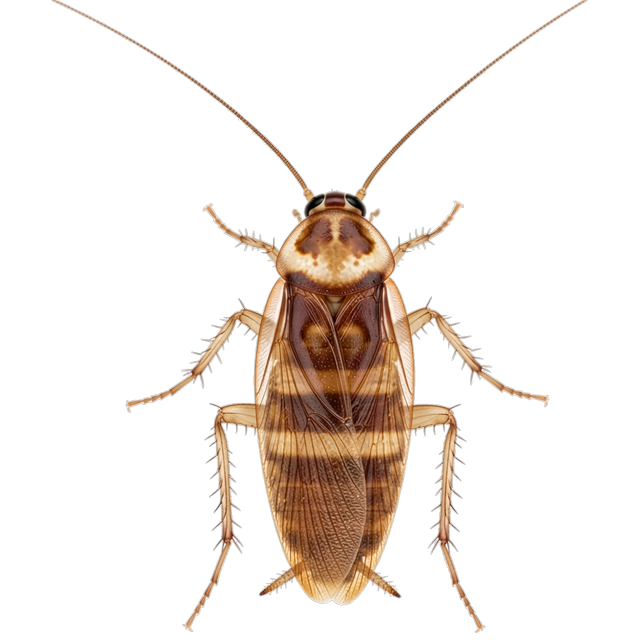
 Brown-banded cockroach
Supella longipalpa (Fabricius, 1798)
Brown-banded cockroach
The cockroach that lives high, on ceilings, picture frames and upper walls, not just under the sink.
- Order
- Blattodea
- Family
- Ectobiidae
- Group
- Cockroaches
- Ontario status
- Established indoors; cannot overwinter outdoors
Why it matters
Same contamination and allergen concerns as other indoor cockroaches. Its habit of living in bedrooms and living rooms, not just kitchens, means infestations are often missed until large.
Origin
Tropical in origin (likely Africa), spread worldwide with commerce; now an indoor species in temperate regions.
Behavior
Nocturnal. Males fly readily when disturbed; females rarely fly. Scatters across ceilings and walls rather than clustering only near plumbing.
Living conditions
Unlike most cockroaches it prefers warm AND dry spots, and lives high up, ceilings, upper walls, inside picture frames, on top of cabinets, near warm electronics.
Signs of presence
- Small cockroaches with two pale bands across the back, seen on upper walls or ceilings
- Tiny purse-shaped egg cases glued to ceilings, furniture undersides, or picture frames
- Activity in dry rooms (bedrooms, living rooms), not just kitchens
Weaknesses
- Cannot overwinter outdoors in Ontario
- Needs warmth, cool rooms suppress it
- Glues its egg cases in the open, where they can be found and removed
Myths and facts
Myth Cockroaches only live near water and plumbing.
Reality The brown-banded cockroach prefers dry, warm, elevated spots, the exception that proves inspections must cover whole rooms.
Research notes
Morphology
Adults 11-14 mm. Males slender, golden-brown, fully winged; females darker, broader, wings cover abdomen. Two pale transverse bands across wings (visible in nymphs as well). Ootheca ~5 mm, reddish-brown, purse-shaped.
Diagnostics
Confirm by the two pale transverse bands + small size + ootheca glued to surfaces (not carried). Male flight when disturbed is characteristic.
Easily confused with
- German cockroach, Blattella germanica German has two dark stripes on the pronotum and carries its ootheca; brown-banded has pale bands across the wings and glues its ootheca to surfaces.
Life cycle
- Adult
- Lifespan ~3-6 months; females produce ~10-14 oothecae.
- Egg
- Ootheca with ~16-18 eggs, glued to ceilings, walls, furniture, hatches in ~50-75 days depending on temperature.
- Egg to adult
- ~90-160 days depending on temperature; fastest near 30 °C
- Generations per year
- 2-3 indoors
- Nymph or larva
- 6-8 nymphal instars; banded pattern visible from early instars.
Development
Incomplete metamorphosis: egg → nymph → adult.
Reproduction
~16-18 eggs per ootheca, ~10-14 oothecae per female.
Distribution
- Global
- Cosmopolitan indoors
- Native range
- Likely tropical Africa
- Ontario
- Established indoors provincewide; cannot overwinter outdoors
Ecology
Xerophilic for a cockroach, prefers warm, dry, elevated harborages. Less tied to plumbing than other indoor species; distributes through entire rooms and furniture.
Resistance
Limited published data; pyrethroid tolerance reported in some populations but less studied than Blattella/Periplaneta.
IPM implications
Inspection must include elevated, dry sites, ceilings, upper walls, picture frames, electronics, not just kitchens and plumbing. Glued oothecae in the open are a monitoring advantage: they are findable and removable. Sticky traps should be placed high as well as low.
Chemical ecology
Supellapyrone identified as a female sex pheromone, a model system in cockroach chemical ecology.
Genetics and DNA
No reference genome published as of 2026.
Taxonomy
Order Blattodea, family Ectobiidae. Described by Fabricius, 1798.
Open questions
Population-level resistance status is poorly characterized relative to other indoor cockroaches.
References
- Ebeling, W. Urban Entomology, UC Riverside
- Mallis Handbook of Pest Control