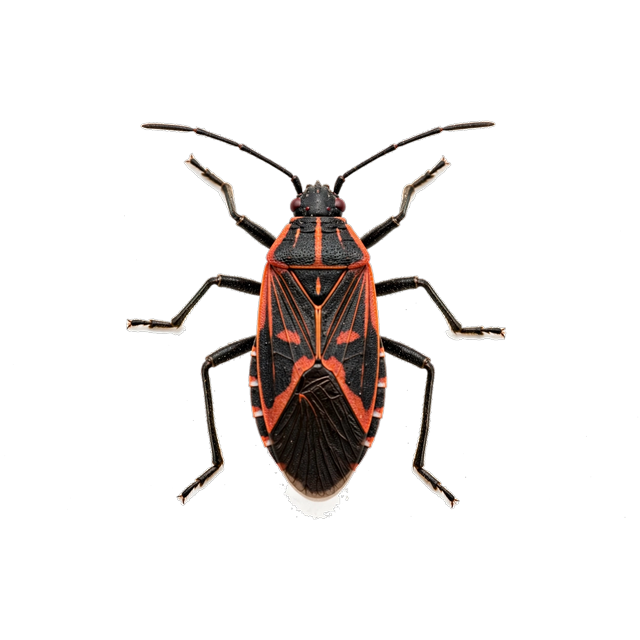
 Boxelder bug
Boisea trivittata (Say, 1825)
Boxelder bug
The black-and-red bug that masses on sunny walls every fall.
- Order
- Hemiptera
- Family
- Rhopalidae
- Group
- Occasional invaders
- Ontario status
- Established, common; overwintering invader
Why it matters
Pure nuisance, no bite, no sting, no structural damage, no disease. The cost is aesthetic: staining from fecal spots and crushed bodies, and the alarm of hundreds of insects on the house.
Origin
Native to North America, where it evolved feeding on the seeds of boxelder trees. Now common across Ontario wherever boxelder, maple, or ash grow.
Behavior
A true bug with piercing-sucking mouthparts built for seeds, not skin, it cannot bite people. Sluggish in cool weather; on warm fall days the wall masses are conspicuous and alarming but harmless.
Living conditions
Lives on host trees through spring and summer. In fall, adults gather by the hundreds on warm, sunlit walls, especially south and west faces, then slip into wall voids, attics, and window frames to overwinter.
Signs of presence
- Dense clusters on sunny exterior walls in September, October
- Bugs appearing indoors at windows on warm winter or spring days
- Reddish-brown fecal spots on walls, curtains, and siding
- Red nymphs on host trees in summer
Weaknesses
- Exclusion before fall: seal siding gaps, utility penetrations, window frames, and soffits in late summer
- Host trees near the house (female boxelder trees are the main draw)
- Sun-warmed walls, the staging ground for entry
Myths and facts
Myth Boxelder bugs bite or are venomous.
Reality Their mouthparts pierce seeds, not skin. They do not bite or feed on people; rare defensive skin punctures have been reported.
Myth A fall invasion means the house is infested.
Reality They do not breed indoors. They are overwintering adults waiting for spring, they will leave (or die) on their own.
Research notes
Morphology
Adults 11-14 mm; black with red-orange markings: three longitudinal pronotal stripes (trivittata = three-banded), red margins on the wings, red abdominal venter; elongated oval body; piercing-sucking rostrum held under the body.
Diagnostics
The red-on-black pattern with three pronotal stripes is unmistakable in Ontario. Nymphs are bright red with black, developing wing pads in later instars.
Easily confused with
- Red-shouldered bug, Jadera haematoloma The red-shouldered bug lacks the three pronotal stripes and is a southern species, rare in Ontario.
Life cycle
- Adult
- Overwinters in wall voids and attics; emerges in spring to mate
- Egg
- Laid in bark crevices and on leaves of host trees, spring
- Egg to adult
- One summer season
- Generations per year
- 1 in Ontario
- Nymph or larva
- 5 instars; bright red early, darkening with wing-pad development
Development
Incomplete metamorphosis: egg → 5 nymphal instars → adult. Eggs laid on host trees in spring; nymphs feed through summer; adults overwinter.
Reproduction
Sexual; eggs deposited on or near boxelder, maple, and ash in spring. One generation per year in northern climates.
Distribution
- Global
- North America; introduced to Chile (first record 2020, Santiago) and Argentina (recorded 2025)
- Native range
- North America
- Ontario
- Established, common; a classic fall overwintering invader of structures
Ecology
Seed predator of Acer negundo (boxelder) primarily, plus other maples and ash. Gregarious at all stages; fall aggregation on sunlit surfaces is thermoregulatory staging before overwintering entry. Native food web role as seed predator and bird prey.
Resistance
Unknown, not a pesticide target; no documented resistance.
IPM implications
Exclusion is the entire program, timed for late summer before fall staging: seal siding and trim gaps, screen vents and weep holes, weatherstrip windows and doors, caulk utility penetrations. Vegetation management, removing female boxelder trees near the structure, reduces the source population. Indoor overwinterers are temporary; vacuum and release or discard. Wall-void treatments are a licensed-operator decision, not a homeowner routine.
Chemical ecology
Rhopalidae are 'scentless plant bugs', they lack the strong defensive aldehydes of stink bugs (Pentatomidae). Aggregation appears driven by thermal cues and conspecific presence rather than identified pheromones.
Genetics and DNA
No reference genome published as of 2026.
Taxonomy
Order Hemiptera, suborder Heteroptera, family Rhopalidae (scentless plant bugs). Boisea trivittata (Say, 1825), formerly Leptocoris trivittata.
Open questions
The cues triggering mass fall aggregation (thermal thresholds vs. photoperiod) are not precisely quantified; overwintering survival rates in Ontario wall voids are undocumented.
References
- University of Minnesota Extension, Boxelder bugs
- Penn State Extension, Boxelder Bug
- Cornell Cooperative Extension, Boxelder Bug Fact Sheet