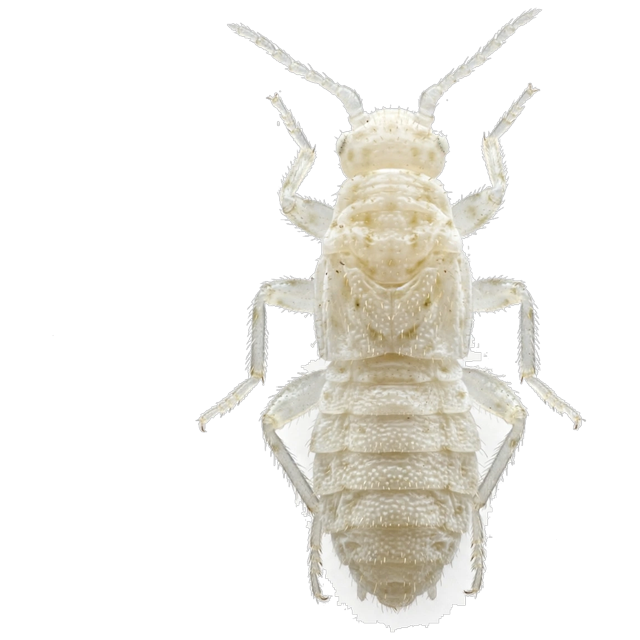
 Booklouse
Liposcelis spp. Motschulsky, 1852
Booklouse
The 2-millimeter alarm bell for damp books, where booklice gather, mold is growing.
- Order
- Psocodea
- Family
- Liposcelididae
- Group
- Silverfish, firebrats & booklice
- Ontario status
- Established, libraries, archives, damp stored goods across Ontario
Why it matters
Booklice are the canary in the coal mine for indoor mold. They don't damage much themselves, but a thriving population means dampness and mold are thriving too, and that is worth fixing for the building and your lungs.
Origin
Wherever humans store paper and grain in damp conditions, worldwide.
Behavior
Grazes on the invisible mold growing on damp paper and grain. Harmless to people, it does not bite and does not eat the book, just the mold on it.
Living conditions
Damp books, old papers in basements, moldy window sills, humid pantries, and grain storage. Wherever it is damp and still.
Signs of presence
- Tiny pale specks moving on damp book pages or moldy surfaces
- Musty odor and visible mold in the same area
- Most noticeable in basements and storage rooms in humid summers
Weaknesses
- Dies out below ~50% humidity, a dehumidifier erases the population
- Has no defenses at all; it survives only where mold grows undisturbed
- Cannot travel far; it arrived with the dampness
- Remove the mold and the food web collapses
Myths and facts
Myth Booklice are baby cockroaches or bed bugs.
Reality Neither, they are their own ancient insect order, harmless, and a fraction of the size. Their presence means mold, which is the actual thing to address.
Research notes
Morphology
1-2 mm; pale gray to tan; soft-bodied; large head relative to body; wingless. Barely visible, most people notice the mold first.
Diagnostics
1-2 mm pale soft-bodied insects on moldy books, paper, or grain, in humid conditions. Confirm mold presence, the mold is the food. Distinguish from bed bug nymphs by size, color, and habitat.
Easily confused with
- Bed bug nymphs (Cimex lectularius) Bed bug nymphs are reddish after feeding, larger, and found near sleeping areas; booklice are pale, smaller, and found on moldy materials.
- Thrips Thrips are darker, feed on plants, and have fringed wings as adults; booklice are wingless and mold-associated.
Life cycle
- Adult
- Adults live weeks to months
- Egg
- Eggs laid singly on the food surface; hatch in ~1 week in warmth
- Egg to adult
- About 1 month in warm humid conditions
- Generations per year
- Continuous while damp
- Nymph or larva
- Nymphs are miniature pale adults; 3-4 molts
Development
Hemimetabolous, egg to nymph to adult; nymphs resemble small adults. Parthenogenetic in many indoor species (all-female populations).
Reproduction
Many indoor species are parthenogenetic, every individual lays eggs, so populations explode fast in damp conditions.
Distribution
- Global
- Worldwide in humid indoor environments
- Native range
- Cosmopolitan with stored goods
- Ontario
- Libraries, archives, damp basements, and grain storage province-wide
Ecology
Mycophagous, grazes the molds growing on paper, grain, and damp surfaces. A moisture indicator species: sustained populations mean sustained dampness and mold growth.
Resistance
Not applicable, managed by moisture control.
IPM implications
Do not treat the insect, treat the moisture. Dehumidify below 50%, dry or discard moldy materials, improve air circulation in storage areas. Booklice are the most honest humidity gauge in the building; their disappearance confirms the fix worked.
Chemical ecology
Feeds on microflora, molds and mildews, not the paper itself. No venom, no defensive chemistry; its ecological chemistry is the mold's.
Genetics and DNA
No reference genome published as of 2026.
Taxonomy
Order Psocodea, family Liposcelididae. Liposcelis is the main indoor genus; several species occur in Ontario buildings and stored grain.
Open questions
Species-level identification of Ontario indoor populations; allergenicity of mass occurrences unstudied.