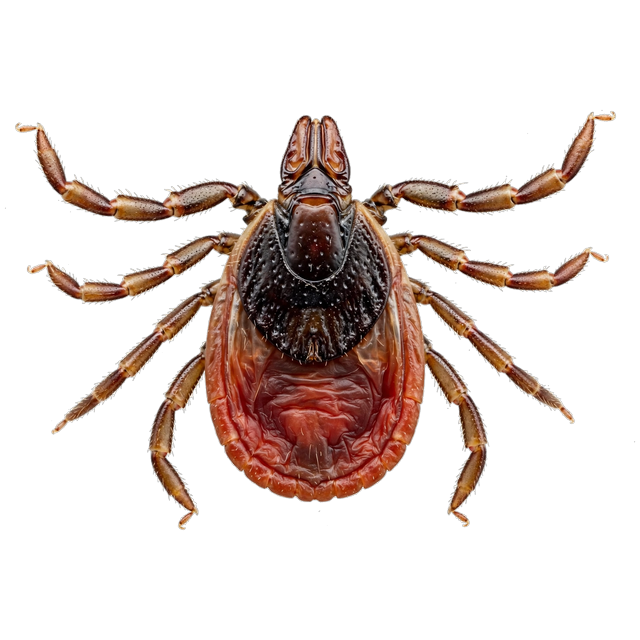
 Black-legged tick
Ixodes scapularis Say, 1821
Black-legged tick
The sesame-seed-sized tick behind Lyme disease, check yourself after the woods, not your basement.
- Order
- Ixodida
- Family
- Ixodidae
- Group
- Ticks & mites
- Ontario status
- Established and expanding, Lyme risk areas across southern and eastern Ontario
Why it matters
It vectors Borrelia burgdorferi (Lyme disease), Anaplasma (anaplasmosis), Babesia (babesiosis), and Powassan virus. Lyme is the main concern in Ontario and it is preventable: the tick must feed for a day or more before the bacteria move. Check yourself, check kids, check dogs.
Origin
Native to eastern North America; its Ontario range is expanding northward as winters warm.
Behavior
Does not jump or fly, it climbs vegetation and waits with outstretched legs (questing), grabbing whatever brushes past. Feeds for days, then drops off. Most active in spring and fall.
Living conditions
Woodland edges, tall grass, leaf litter, and trails, not inside homes and not on mowed lawns. You meet it on hikes, at the cottage, or where the yard meets the woods.
Signs of presence
- Ticks on clothing or pets after time in woods or tall grass
- A tiny dark poppy-seed-sized speck attached to skin (nymph)
- A larger tick with a reddish body attached behind ears, in armpits, or at the waistline
- A spreading circular rash days after a bite, see a doctor and mention the tick
Weaknesses
- Must feed for 24-36 hours to transmit Lyme, prompt removal breaks the chain
- Desiccates quickly in dry, sunny, mowed areas; cannot survive on lawns
- Vulnerable at every stage to desiccation and to being brushed off before attaching
- Requires leaf litter and humidity, clearing leaf litter from yard edges removes its habitat
Myths and facts
Myth Ticks fall out of trees onto people.
Reality They quest from low vegetation, knee height at most. The danger zone is brushing through tall grass and leaf litter, not standing under trees.
Myth A tick bite means you will get Lyme disease.
Reality Transmission of Lyme bacteria typically requires 24-36 hours of attachment. A tick found and removed the same day is very unlikely to have transmitted it, but save the tick for identification.
Research notes
Morphology
Unfed nymph 1-2 mm (poppy seed); unfed adult female ~3 mm with distinctive orange-red abdomen behind a dark scutum; males smaller, dark. Eight legs as nymph/adult; mouthparts long and visible from above (Ixodes hallmark). Engorged females swell to ~10 mm.
Diagnostics
Inornate (unpatterned) dark scutum; long mouthparts; nymphs poppy-seed sized with 8 legs. Confirm with tick keys or public-health lab submission, Ontario public health accepts tick submissions for identification.
Easily confused with
- American dog tick (Dermacentor variabilis) Dog ticks are larger with ornate white markings on the scutum; deer ticks are inornate and smaller.
- Lone star tick (Amblyomma americanum) Lone star ticks have a single white spot (females); not established in Ontario.
Life cycle
- Adult
- Adults quest in fall and early spring; females lay 1,000-3,000 eggs in leaf litter and die
- Egg
- Eggs laid in spring in moist leaf litter; hatch in weeks
- Egg to adult
- Typically 2 years in Ontario; 3 years in colder zones
- Generations per year
- One generation spans 2-3 years
- Nymph or larva
- Larva feeds once (summer), molts to nymph; nymph feeds once (spring-summer, the peak Lyme-transmission stage), molts to adult
Development
Egg to six-legged larva to eight-legged nymph to adult; one blood meal per active stage (three-host cycle). Molting requires the blood meal.
Reproduction
Females take one large blood meal, drop off, and lay a single massive egg batch (thousands) in leaf litter. Males may mate on or off the host.
Distribution
- Global
- Eastern North America
- Native range
- Eastern North America
- Ontario
- Established in expanding zones across southern, eastern, and parts of northern Ontario; range tracked by public-health surveillance and moving northward with climate
Ecology
Three-host questing tick. Larvae and nymphs feed on rodents and birds (the reservoir hosts for Borrelia); adults feed on deer (reproductive hosts, not reservoirs). Habitat: deciduous woodland edges, tall grass, leaf litter, not lawns or homes.
Resistance
Some acaricide tolerance reported in U.S. populations; Ontario status under surveillance. Not a crisis, but monitor.
IPM implications
Monitoring: drag-sampling and public tick submissions map risk; personal tick checks are the primary intervention. Landscape IPM is habitat-based, leaf-litter removal, wood-chip barriers, deer exclusion, not broadcast chemistry. Area acaricide application is a licensed-operator activity with strict limits near water and pollinators. Client education (proper tick removal, 24-36h attachment threshold for Lyme transmission) is the highest-value service.
Chemical ecology
Saliva is a pharmacological cocktail, anticoagulants, immunosuppressants, and cement proteins that anchor the mouthparts. Salivary proteins are vaccine targets. Pheromones coordinate aggregation on hosts (assembly pheromones on vegetation).
Genetics and DNA
Genome published (Ixodes scapularis), vector biology model for Lyme disease.
Taxonomy
Order Ixodida, family Ixodidae (hard ticks). Authority Say, 1821. Formerly Ixodes dammini, synonymized with scapularis; the Lyme vector of eastern North America.
Open questions
How fast range expansion will proceed under warming; evolving pathogen prevalence in new Ontario populations.
References
- Sonenshine, D.E. & Roe, R.M. (2014). Biology of Ticks, 2nd ed., Oxford University Press.
- Krantz, G.W. & Walter, D.E. (2009). A Manual of Acarology, 3rd ed., Texas Tech University Press.
- CDC, Tick information (cdc.gov/ticks).