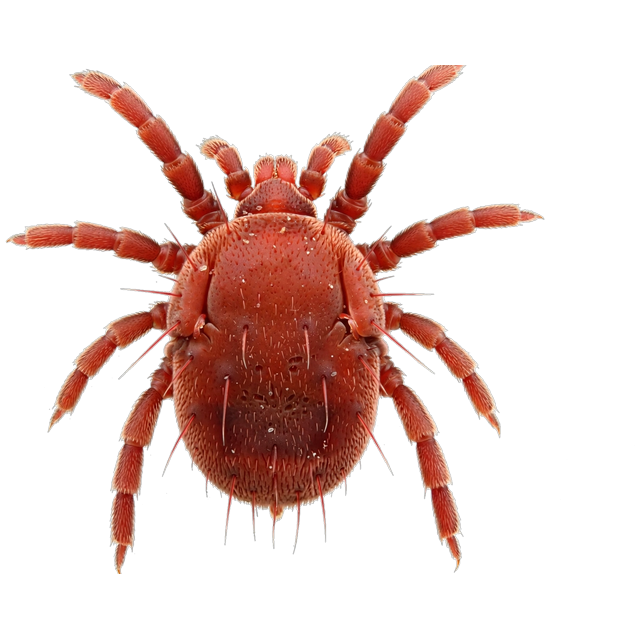
 Bird mite
Ornithonyssus spp. Sambon, 1928
Bird mite
The invisible biter that appears when the birds leave, if it itches after a nest was removed, suspect this mite.
- Order
- Mesostigmata
- Family
- Macronyssidae
- Group
- Ticks & mites
- Ontario status
- Established, follows nesting birds (pigeons, starlings, sparrows) on buildings
Why it matters
Bird mites cause miserable, intensely itchy bites and a lot of misdiagnosed 'mystery infestations', but they cannot establish on people, and the fix is finding the old nest, not fumigating the bedroom.
Origin
Wherever birds nest, these mites have followed pigeons, starlings, and sparrows onto human buildings worldwide.
Behavior
Lives in bird nests by the thousands. When the baby birds leave, the hungry mites pour out of the nest looking for anything warm, including people in the rooms below. They bite, but they cannot live on you.
Living conditions
In and around bird nests on buildings, under eaves, in vents, behind shutters, in window air conditioners. The problem starts days after the birds leave.
Signs of presence
- Intense itching and tiny red bite marks appearing days after birds vacate a nest
- Mites visible as moving specks on walls and ceilings near the old nest site
- A recently active bird nest on the building exterior (eaves, vents)
- Bites concentrated on people sleeping or working directly below the nest
Weaknesses
- Cannot reproduce on human blood, the infestation ends on its own once the nest is gone
- Dies within weeks without a bird host
- Completely dependent on the nest as its base, remove the nest, remove the problem
- Vulnerable to vacuuming during the dispersal window
Myths and facts
Myth The mites are coming from my mattress / my dog.
Reality Bird mites come from bird nests, full stop. Treating the bedroom or the pet misses the actual source on the outside of the building.
Research notes
Morphology
0.7-1.0 mm; oval, reddish-brown when fed, grayish when starved. Eight legs; barely visible to the naked eye, most people feel them before seeing them.
Diagnostics
Tiny mites + biting complaints + recent bird-nest activity on the building = bird mites until proven otherwise. Microscopic ID to species needs an acarologist; genus-level management is identical.
Easily confused with
- Tropical rat mite (Ornithonyssus bacoti) Rodent mites are associated with rat/mouse nests, not bird nests; host-nest context is the practical separator.
- Clover mite (Bryobia praetiosa) Clover mites are plant feeders found on sunny walls and windowsills; they do not bite.
Life cycle
- Adult
- Adults feed on nestling birds; survive weeks without a host while dispersing
- Egg
- Eggs laid in nest material; hatch in 2-3 days in warmth
- Egg to adult
- About 7 days in warm nests, one of the fastest mite life cycles
- Generations per year
- Continuous while birds are nesting
- Nymph or larva
- Larva does not feed; the protonymph takes a blood meal; the deutonymph is a brief non-feeding stage
Development
Egg to six-legged larva to protonymph to deutonymph to adult; completes in about a week in warm conditions, explosive population growth in an active nest.
Reproduction
Females lay eggs continuously in the nest; a single starling nest can produce tens of thousands of mites. Dispersal is triggered by host departure, not season.
Distribution
- Global
- Worldwide wherever birds nest on structures
- Native range
- Cosmopolitan with birds
- Ontario
- Wherever pigeons, starlings, and sparrows nest on buildings, cities province-wide
Ecology
Obligate bird-nest parasite; disperses en masse when fledglings leave and the nest is abandoned. Bites humans opportunistically but cannot reproduce on us, a dead-end infestation that ends when the source is removed.
Resistance
Unknown, managed by source removal, not chemicals; no documented resistance.
IPM implications
This is a source-reduction case, not a chemical case: find the abandoned nest (eaves, vents, window AC units), remove it after nesting season and in compliance with wildlife regulations, then vacuum the dispersal zone. Treating the rooms without removing the nest fails every time. Bird exclusion (netting, vent screening) prevents recurrence.
Chemical ecology
Hematophagous, saliva contains anticoagulants; human bites produce papular dermatitis. Cannot complete reproduction on human blood; infestations self-terminate once the bird source is gone.
Genetics and DNA
No reference genome published as of 2026.
Taxonomy
Order Mesostigmata, family Macronyssidae. Ornithonyssus sylviarum (northern fowl mite) and O. bursa (Berlese, 1888) (tropical fowl mite) are the usual building-associated species; management is identical.
Open questions
Species boundaries within Ornithonyssus on Ontario buildings; dispersal distances after nest abandonment.
References
- Krantz, G.W. & Walter, D.E. (2009). A Manual of Acarology, 3rd ed., Texas Tech University Press.
- Ebeling, W. (1978). Urban Entomology, University of California, Riverside.