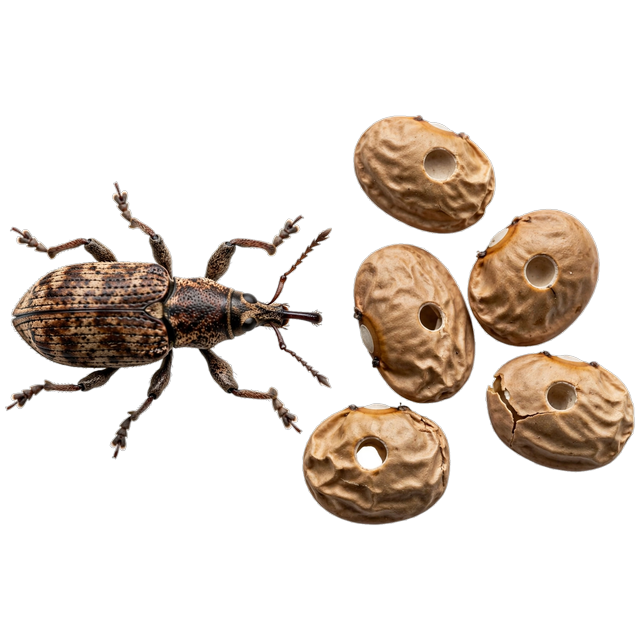
 Bean weevil
Acanthoscelides obtectus (Say, 1831)
Bean weevil
A beetle that starts eating your beans while they're still growing in the field, and finishes the job in the storage jar.
- Order
- Coleoptera
- Family
- Chrysomelidae
- Group
- Stored-product beetles
- Ontario status
- Established, in Ontario mainly a pest of stored dry beans and in seed storage; also infests beans in the field
Why it matters
The main insect pest of stored dry beans in Ontario, from home pantries to seed warehouses. Unlike grain weevils, the infestation often starts before harvest.
Origin
Tropical Americas, where wild and cultivated beans grow; spread worldwide with the bean trade.
Behavior
Females lay eggs on maturing bean pods in the field; larvae bore into the seeds and keep developing in storage. Adults chew neat round exit holes to emerge, the classic 'wormy bean' look.
Living conditions
Dry beans, kidney, navy, pinto, black beans, in the field as pods mature and in storage jars and warehouses afterward.
Signs of presence
- Round ~2 mm exit holes in dry beans
- Tiny beetles (3-5 mm) in bean jars or bulk bins
- Powdery frass among stored beans
Weaknesses
- Killed by freezing (a few days at -18 °C)
- Cannot reinfest indefinitely without new beans, the cycle ends when the beans run out
- Field infestation can be reduced by prompt harvest and drying
Myths and facts
Myth The holes mean the beans were already rotten.
Reality The holes are exit doors chewed by emerging adults. The bean was fine, the larva grew up inside it.
Research notes
Morphology
3-5 mm, mottled brown and gray, compact oval body. Short blunt head (no snout, the weevil distinction). Elytra shortened, exposing the pygidium (abdominal tip). Hind femora enlarged.
Diagnostics
Round emergence holes in beans + short-snouted mottled beetle = bean weevil. The exposed pygidium separates bruchids from true weevils.
Easily confused with
- Granary weevil, Sitophilus granarius True weevils have a long snout; the bean weevil has essentially none, and attacks beans, not cereal grain.
Life cycle
- Adult
- Chews round exit hole; lives a few weeks; mates and reinfests
- Egg
- Laid on pods in the field or on beans in storage; hatch in ~1 week
- Egg to adult
- 4-8 weeks depending on temperature
- Generations per year
- Several overlapping generations in storage; field generation initiates the cycle
- Nymph or larva
- Larva bores into the seed and feeds 2-4 weeks, pupates inside
Development
Complete metamorphosis: egg → larva → pupa → adult, inside the seed.
Reproduction
Females lay ~50-100 eggs on pods or beans.
Distribution
- Global
- Cosmopolitan in bean trade
- Native range
- Tropical Americas
- Ontario
- Established; stored beans, seed warehouses, home pantries
Ecology
Field-to-storage bridge species, unusual among stored-product beetles in initiating infestation pre-harvest. Larval competition within seeds is intense; usually one larva per seed survives.
Resistance
Unknown, no significant documented resistance.
IPM implications
Because infestation starts in the field, storage-only sanitation is insufficient, incoming beans should be inspected, and freezing incoming lots kills hidden larvae. Prompt harvest and rapid drying reduce field-origin pressure.
Chemical ecology
Host volatiles from maturing pods guide oviposition; limited pheromone work.
Genetics and DNA
No reference genome published as of 2026.
Taxonomy
Order Coleoptera, family Chrysomelidae, subfamily Bruchinae (seed beetles; historically family Bruchidae). Despite the name, not a true weevil, no rostrum.
Open questions
Field-to-storage population continuity: what fraction of storage infestations trace to field-laid eggs vs. storage reinfestation.
References
- Hagstrum, D.W. & Subramanyam, B. (2006). Fundamentals of Stored-Product Entomology. AACC International.