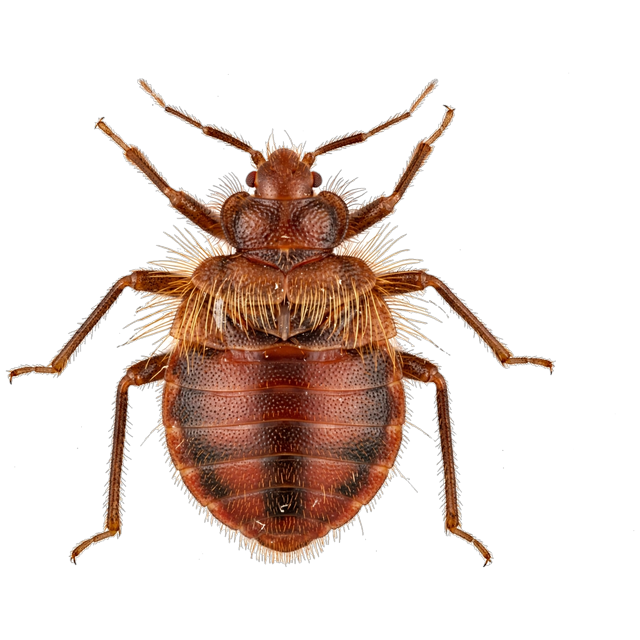
 Bat bug
Cimex pilosellus (Horváth, 1910)
Bat bug
The bed bug's twin that feeds on bats, it only bothers people when the bats leave.
- Order
- Hemiptera
- Family
- Cimicidae
- Group
- Bed bugs & relatives
- Ontario status
- Established where bat hosts occur; sporadic indoor records
Why it matters
Bites people when its bat hosts are gone, causing the same itchy welts as bed bugs. The key point: treating it like a bed bug infestation misses the actual source, the bat roost.
Origin
Native to North America, living with bats for millennia, it is the wild cousin of the bed bug.
Behavior
Feeds on bats at night. If the bats are excluded from an attic, hungry bat bugs migrate downward into bedrooms seeking a new host, people.
Living conditions
Lives in bat roosts: attics, chimneys, wall voids where bats colony. Only wanders into living spaces when bats leave or are removed.
Signs of presence
- Bed-bug-like insects appearing after bats are removed from an attic
- Bugs concentrated on upper floors and ceilings near the former roost
- Bat droppings (guano) or bat activity in the attic above
Weaknesses
- Depends on bat hosts, no bats, no sustainable population
- Cannot fly; limited to crawling from the roost
- Exposed once the roost is found and managed
Myths and facts
Myth Bat bugs and bed bugs are the same thing.
Reality They are separate species. Bat bugs need bats; without resolving the bat roost, bat bugs keep coming.
Research notes
Morphology
Nearly identical to Cimex lectularius: 4-5 mm, oval, reddish-brown, wingless. Diagnostic: pronotal fringe hairs LONGER than the width of the eye (in bed bugs, shorter than eye width). Slightly hairier overall appearance.
Diagnostics
Confirm by pronotal hair length (longer than eye width) + association with a bat roost (guano, roosting bats, attic location). Microscopic examination required.
Easily confused with
- Bed bug, Cimex lectularius Bed bug pronotal hairs are shorter than the eye width; bat bug hairs are longer. Ecology differs: beds vs. bat roosts.
Life cycle
- Adult
- Lifespan several months; survives extended host absence.
- Egg
- ~1 mm white eggs laid in roost crevices.
- Egg to adult
- Several weeks to months depending on temperature and host availability
- Generations per year
- Fewer than bed bugs; tied to bat roosting season
- Nymph or larva
- 5 nymphal instars, each requiring a blood meal (normally bat blood).
Development
Incomplete metamorphosis: egg → nymph → adult.
Reproduction
Traumatic insemination as in Cimex; fecundity lower and more seasonal than the bed bug.
Distribution
- Global
- North America
- Native range
- North America
- Ontario
- Occurs wherever colonial bats roost in structures; sporadic bedroom records follow bat exclusions
Ecology
Obligate associate of colonial bats (e.g., big brown bat, little brown bat). Harborage in roost crevices; follows bats. Human biting is incidental after bat exclusion or roost abandonment.
Resistance
No published data, not an insecticide target species.
IPM implications
The management unit is the bat roost, not the bedroom: inspect attics, chimneys and wall voids for bats/guano whenever 'bed bugs' appear on upper floors after a bat exclusion. Bat exclusion itself is regulated (maternity season protections), coordinate with wildlife regulations. Treating the bedroom without addressing the roost guarantees recurrence.
Chemical ecology
Presumed similar aggregation and alarm chemistry to Cimex lectularius; not well characterized.
Genetics and DNA
No reference genome published as of 2026.
Taxonomy
Order Hemiptera, family Cimicidae, genus Cimex. Described by Horváth, 1910. Nearctic bat associate.
Open questions
Host-switching frequency to humans; population genetics relative to Cimex lectularius. Note: Ontario bat-bug records may refer to the eastern bat bug Cimex adjunctus rather than the western C. pilosellus, species-level confirmation pending.
References
- Mallis Handbook of Pest Control
- Potter, M.F. University of Kentucky Entomology extension (cimicid biology)