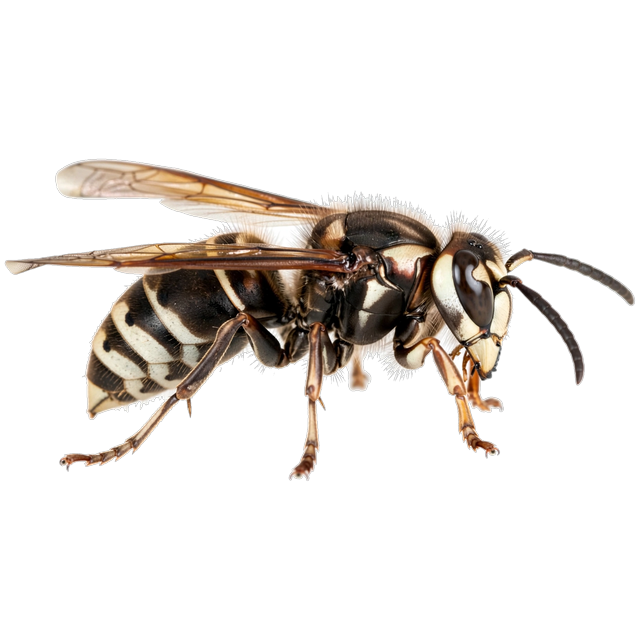
 Bald-faced hornet
Dolichovespula maculata Linnaeus, 1763
Bald-faced hornet
Big black-and-white wasps in hanging paper footballs, fierce at the nest, useful predators away from it.
- Order
- Hymenoptera
- Family
- Vespidae
- Group
- Wasps, hornets & bees
- Ontario status
- Established, native
Why it matters
The most defensive common wasp in Ontario near its nest, multiple painful stings, allergy risk. But ecologically valuable: each colony removes thousands of flies and caterpillars. Nests away from human traffic are best left alone.
Origin
Native across North America, from coast to coast.
Behavior
Hunts flies, caterpillars and other yellowjackets to feed its young, a beneficial predator. Extremely defensive within a few metres of the nest; will pursue intruders. Away from the nest, not aggressive.
Living conditions
Builds large grey paper nests hanging from tree branches, shrubs, and building eaves, the classic 'paper football', sometimes basketball-sized.
Signs of presence
- A large grey papery nest hanging in a tree or under an eave
- Big black-and-white wasps patrolling a fixed flight path to the nest
- Increased wasp traffic after lawn equipment vibrates nearby
Weaknesses
- Defence is nest-centred, away from the nest they want nothing to do with you
- Single-season colonies; winter kills the nest
- Nests are conspicuous and locatable
- Queens found alone in spring
Myths and facts
Myth They're true hornets and will chase you for blocks.
Reality They're aerial yellowjackets, not true hornets. They defend a zone around the nest, usually a few metres, not the neighbourhood.
Research notes
Morphology
Workers ~12-20 mm; queens to ~25 mm. Black with ivory-white markings: white face ('bald-faced'), white-tipped abdomen. Builds enclosed aerial paper nests with a layered envelope, grey, football-shaped, single entrance at the bottom.
Diagnostics
Confirm by: 15-20 mm black-and-white (not yellow), white face, large hanging enclosed paper nest.
Easily confused with
- European hornet, Vespa crabro European hornets are larger, brown-and-yellow (not black-and-white), and nest in cavities, never in hanging paper footballs.
Life cycle
- Egg
- Queen builds the first comb and lays eggs in spring
- Nymph or larva
- Larvae fed chewed prey (flies, caterpillars, other wasps) by workers
- Adult
- Colony peaks at a few hundred workers in late summer; only mated queens overwinter
- Egg to adult
- Approximately 3-4 weeks per worker generation
- Generations per year
- One colony cycle per year
Development
Complete metamorphosis: egg → larva → pupa → adult. Annual eusocial colony.
Reproduction
Single queen founds; autumn rears males and new queens; colony dies with frost.
Distribution
- Native range
- North America
- Ontario
- Common throughout; nests conspicuous from midsummer
- Global
- North America
Ecology
Aerial nester in trees, shrubs and on structures. Predatory, significant consumer of flies (including house flies) and caterpillars; also scavenges. Smaller colonies than ground yellowjackets (hundreds, not thousands) but more aggressive per capita near the nest.
Resistance
Not applicable, no insecticide resistance documented.
IPM implications
Risk-based decision: nests high in trees away from traffic are a net benefit (fly and caterpillar predation) and best left until winter kills them. Nests on structures, at doorways, or near play areas warrant professional removal, ideally at night when the colony is home, by licensed operators with protective equipment. The single-season biology means 'wait until winter' is a legitimate strategy for low-risk nests.
Chemical ecology
Nestmate recognition and alarm pheromones; prey location primarily visual.
Genetics and DNA
No reference genome published as of 2026.
Taxonomy
Hymenoptera: Vespidae. Dolichovespula maculata (Linnaeus, 1763). An aerial-nesting yellowjacket; 'hornet' is a common name, not a taxonomic rank here.
Open questions
Prey spectra in Ontario urban vs. rural colonies; overwintering site selection by queens.
References
- Akre et al., Dolichovespula biology, primary literature
- Evans & Eberhard (1970), The Wasps (Univ. Michigan Press)
- Penn State Extension, bald-faced hornets