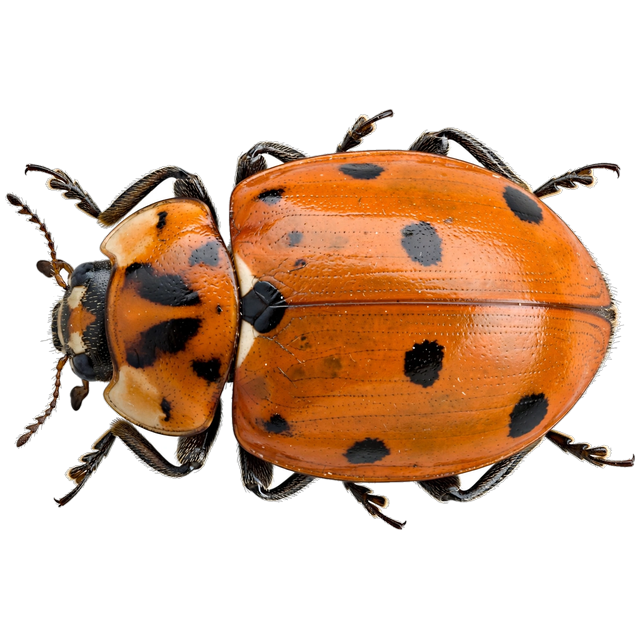
 Asian lady beetle
Harmonia axyridis (Pallas, 1773)
Asian lady beetle
The helpful garden ladybug that overstays its welcome, thousands of them, in your walls, every fall.
- Order
- Coleoptera
- Family
- Coccinellidae
- Group
- Occasional invaders
- Ontario status
- Invasive, established; major fall overwintering nuisance across Ontario
Why it matters
A paradox in a shell: superb aphid control in the garden, miserable home invader in the fall, competitor displacing native ladybugs, and a wine-industry headache. Manage the migration, respect the predator.
Origin
East Asia; brought to North America on purpose to eat crop aphids, then it ate the natives' lunch too.
Behavior
Eats aphids all summer, a gardener's friend, then swarms sun-warmed walls in fall by the thousands to find winter shelter. May nip exposed skin and releases stinky yellow fluid when disturbed.
Living conditions
Gardens and soybean fields in summer; the sunny sides of houses in October; wall voids and attics all winter.
Signs of presence
- Swarms of orange lady beetles on sunny walls in October
- Beetles indoors at windows through winter
- Yellow staining and a musty odor where they were crushed
- Bites or nips on exposed skin during heavy fall flights
Weaknesses
- Cannot survive winter exposed, it must get inside, so exclusion defeats it
- Vacuumed easily in bulk; the aggregation habit is its vulnerability
- The M-mark makes it identifiable, so you know exactly what you're dealing with
- Outdoor populations are beneficial, the problem is purely the indoor migration
Myths and facts
Myth They're just ladybugs, completely harmless and welcome everywhere.
Reality They're an introduced species that outcompetes our native ladybugs, invades homes by the thousand, can trigger allergies, and ruins wine vintages. Helpful, but not harmless.
Research notes
Morphology
Body 5-8 mm; dome-shaped; color wildly variable (tan-orange to red, 0 to 19+ spots, occasionally black with red spots); white pronotum with black M/W mark. The pronotum mark is the reliable character.
Diagnostics
The M- or W-shaped marking on the white pronotum is the field mark. Color varies wildly (orange to red to black, 0-19 spots), never rely on spots.
Easily confused with
- Native lady beetles (Coccinella spp., Hippodamia spp.) Native lady beetles lack the M/W marking and are usually uniformly red with consistent spotting; H. axyridis is wildly variable.
Life cycle
- Adult
- Adults overwinter in wall voids; emerge in spring
- Egg
- Yellow spindle-shaped eggs in clusters on leaves; hatch in ~1 week
- Egg to adult
- 3-4 weeks in summer warmth
- Generations per year
- 2-3 in Ontario
- Nymph or larva
- Spiny dark larvae with orange markings; ferocious aphid predators
Development
Holometabolous, egg to larva (spiny, alligator-like, aphid-eating) to pupa to adult. Larvae are the more voracious predators.
Reproduction
High fecundity, hundreds of eggs per female across the season; multiple generations compound into fall's millions.
Distribution
- Global
- East Asia native; introduced worldwide for biocontrol, now invasive in North America and Europe
- Native range
- East Asia
- Ontario
- Established and abundant; fall aggregations on buildings province-wide
Ecology
Introduced as an aphid biocontrol agent; too successful, it outcompetes native lady beetles, invades homes to overwinter, and taints wine grapes (its alkaloids survive into wine as 'ladybug taint'). A biocontrol cautionary tale.
Resistance
Unknown, managed by exclusion; no documented resistance.
IPM implications
Exclusion before the fall flight (seal south/west exposures); vacuum indoor aggregations, never crush (staining, odor, allergens). Outdoors, protect it: it remains a superb aphid predator in gardens. The dual status, garden ally, home invader, must be communicated clearly; blanket treatment of garden populations is ecologically costly.
Chemical ecology
Reflex bleeding, exudes yellow alkaloid-rich hemolymph (harmonine and others) from leg joints when disturbed; bitter, staining, and allergenic to some people. Aposematic coloration backs the chemistry.
Genetics and DNA
Multiple reference genomes published, including a 423-Mb chromosome-level assembly (Chen et al., Mol Ecol Resour 2021) and the Darwin Tree of Life 426-Mb chromosome-scale assembly.
Taxonomy
Order Coleoptera, family Coccinellidae. Authority (Pallas, 1773). Deliberately introduced to North America for aphid control; a textbook biocontrol-gone-sideways case.
Open questions
Long-term impact on native coccinellid diversity in Ontario; wine-taint mitigation in vineyards.
References
- Ebeling, W. (1978). Urban Entomology, University of California, Riverside.