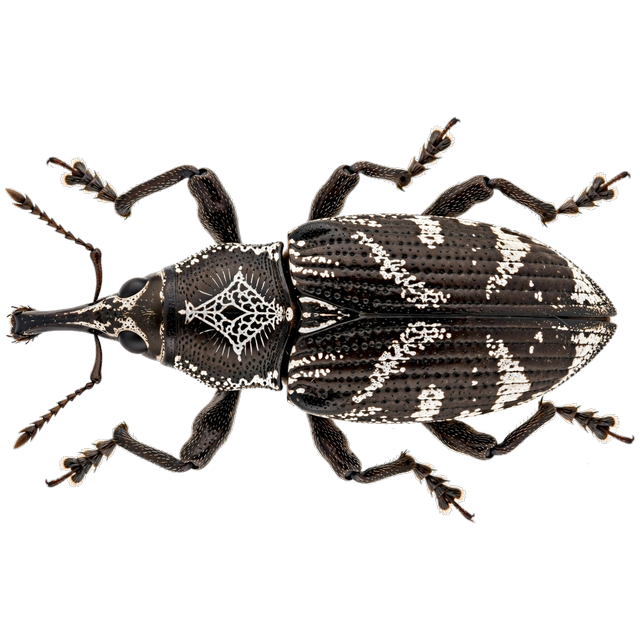
 American dog tick
Dermacentor variabilis (Say, 1821)
American dog tick
The big ornate tick your dog brings home from the field, a spring and summer biter.
- Order
- Ixodida
- Family
- Ixodidae
- Group
- Ticks & mites
- Ontario status
- Established, southern Ontario; expanding with warming climate
Why it matters
It can transmit Rocky Mountain spotted fever (Rickettsia rickettsii) and tularemia, both rare in Ontario but serious. Its main everyday impact is as the tick your dog brings home. Prompt removal and pet prevention handle nearly all of the risk.
Origin
Native to eastern and central North America; long established in southern Ontario and pushing north.
Behavior
Waits on grass and low plants for a passing dog, deer, or person. Adults are most active in spring and early summer. Attaches and feeds for days.
Living conditions
Grassy fields, meadows, trail edges, and unmowed verges, not deep woods, not homes. Your dog meets it on walks; you meet it on hikes.
Signs of presence
- Large ticks with white-patterned backs on dogs after walks
- Ticks attached at the hairline, behind ears, or on the scalp
- Spring and summer tick encounters in grassy areas
- Engorged grayish ticks the size of a grape on pets
Weaknesses
- Large and visible, easier to find and remove than deer ticks
- Needs tall grass and humidity; mowed, sunny yards are hostile to it
- Each stage must find a host or die trying, breaking the host chain breaks the tick
- Dogs on veterinary tick prevention become dead-end hosts
Myths and facts
Myth Dog ticks only bite dogs.
Reality They feed readily on people too, the name just reflects how often dogs bring them home. Check yourself, not just the dog.
Research notes
Morphology
Unfed adult female ~5 mm, engorged up to 15 mm; males ~3-4 mm. Reddish-brown with distinctive white/cream ornate markings on the scutum. Eight legs; short mouthparts (Dermacentor hallmark). Larger and showier than the deer tick.
Diagnostics
Ornate white markings on the scutum (both sexes), larger size than Ixodes, short mouthparts. Submit to public-health labs for confirmation where RMSF is a concern.
Easily confused with
- Black-legged tick (Ixodes scapularis) Deer ticks are smaller, unorned, and lack white markings; dog ticks are larger with a boldly patterned back.
- Lone star tick (Amblyomma americanum) Lone star ticks have a single white spot (females) or horseshoe marking (males); not established in Ontario.
Life cycle
- Adult
- Adults quest spring-summer; females lay 4,000-6,500 eggs in sheltered soil and die
- Egg
- Eggs laid in masses in spring; hatch in ~1 month in warmth
- Egg to adult
- Up to 2 years; can extend to 3 in poor conditions
- Generations per year
- One generation spans up to 2 years
- Nymph or larva
- Larva and nymph each take one blood meal from small mammals, then molt
Development
Egg to larva to nymph to adult; one blood meal per stage (three-host cycle). Larvae and nymphs feed mainly on rodents; adults on medium-large mammals including dogs and humans.
Reproduction
Very high fecundity: a single female lays 4,000-6,500 eggs. Mating occurs on the host, attracted by female pheromones.
Distribution
- Global
- North America, east of the Rockies primarily
- Native range
- Eastern and central North America
- Ontario
- Established in southern Ontario; records expanding northward; common in grassy fields and along trails
Ecology
Field and meadow questing tick; dogs are frequent hosts (hence the name) but it feeds readily on humans. Larvae/nymphs on rodents, adults on larger mammals. Peak adult activity: spring through summer.
Resistance
Unknown, under surveillance; not a major documented issue in Ontario.
IPM implications
Monitoring: tick drags in field habitat; pet checks. Management is host- and habitat-based, keep grass short along trails, veterinary tick prevention for dogs, personal checks after field exposure. Same licensed-operator constraints as black-legged tick for any area treatment.
Chemical ecology
Saliva contains anticoagulants and immunomodulators; females produce sex pheromones that attract males to the feeding site. Aggregation pheromones concentrate questing ticks on vegetation.
Genetics and DNA
Genome published 2025 (Cassens et al., G3: 2.15 Gb assembly, 21,722 predicted genes, BUSCO 95.2%).
Taxonomy
Order Ixodida, family Ixodidae. Authority (Say, 1821). The classic 'wood tick' of eastern North America.
Open questions
Northward expansion rate in Ontario; Rickettsia prevalence in Ontario populations.
References
- Sonenshine, D.E. & Roe, R.M. (2014). Biology of Ticks, 2nd ed., Oxford University Press.
- Krantz, G.W. & Walter, D.E. (2009). A Manual of Acarology, 3rd ed., Texas Tech University Press.
- CDC, Tick information (cdc.gov/ticks).