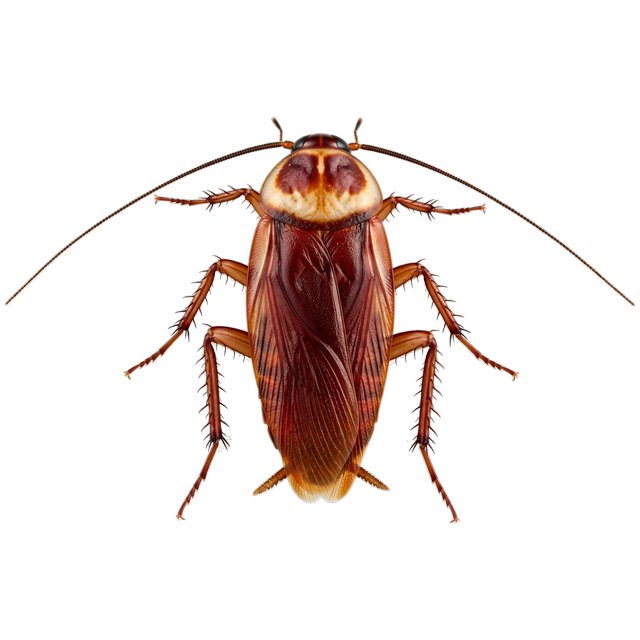
 American cockroach
Periplaneta americana (Linnaeus, 1758)
American cockroach
The giant of indoor cockroaches, up to 5 cm long, living in sewers, basements and steam tunnels.
- Order
- Blattodea
- Family
- Blattidae
- Group
- Cockroaches
- Ontario status
- Established indoors (sewers, large buildings); cannot overwinter outdoors
Why it matters
Travels through sewers and decaying matter, so it can carry germs onto food-contact surfaces. Its size and sewer habit make it alarming, though it bites nothing and stings nothing.
Origin
Not from America either, likely Africa or the Middle East in origin, spread worldwide centuries ago on ships.
Behavior
Nocturnal; forages at night and glides short distances on its wings when disturbed. Often enters buildings from sewers through floor drains.
Living conditions
Loves warm, damp, dark places: sewers, storm drains, basements, boiler rooms, steam tunnels. In Ontario it lives indoors in large buildings, not in houses generally.
Signs of presence
- Very large (35-50 mm) reddish-brown cockroaches, often near drains or basements
- Purse-shaped egg cases (~8 mm) dropped in damp hiding spots
- Musty odor in enclosed damp areas
- Shed skins near sewer access points
Weaknesses
- Cannot survive an Ontario winter outdoors
- Needs constant moisture, dry buildings exclude it
- Slow breeder compared to the German cockroach, so populations grow more slowly
Myths and facts
Myth It is called a 'palmetto bug' so it must be a different insect.
Reality 'Palmetto bug' is just a regional nickname for the American cockroach.
Myth Big cockroaches fly into your hair on purpose.
Reality They glide clumsily when startled; they are not targeting people.
Research notes
Morphology
Adults 35-50 mm, reddish-brown with a pale yellowish margin around the pronotum. Both sexes winged; males' wings extend slightly beyond the abdomen. Nymphs uniformly reddish-brown, wingless.
Diagnostics
Confirm by size (35-50 mm) + pale pronotal margin + purse-shaped ootheca dropped (not carried). Cerci prominent.
Easily confused with
- Smokybrown cockroach, Validiblatta fuliginosa (syn. Periplaneta fuliginosa) Smokybrown is uniformly dark mahogany with no pale pronotal margin; American always shows the pale margin.
- Oriental cockroach, Blatta orientalis Oriental is smaller (20-30 mm), darker, and females are short-winged; American females are fully winged.
Life cycle
- Adult
- Lifespan up to ~1 year; females produce oothecae at roughly weekly intervals in warm conditions.
- Egg
- Purse-shaped ootheca (~8 mm) with ~14-16 eggs, dropped or glued in moist crevices; hatches in ~50-55 days at 28 °C.
- Egg to adult
- 5-15 months depending on temperature, much slower than the German cockroach
- Generations per year
- ~1 indoors
- Nymph or larva
- 13 nymphal instars; development slow.
Development
Incomplete metamorphosis: egg → nymph → adult.
Reproduction
~14-16 eggs per ootheca, produced roughly weekly by each female under warm conditions.
Distribution
- Global
- Cosmopolitan in warm regions; indoor/sewer populations in temperate zones
- Native range
- Likely Africa or the Middle East
- Ontario
- Established indoors in large buildings, sewers and institutions; cannot overwinter outdoors
Ecology
Peridomestic and sewer-dwelling; strongly associated with decaying organic matter, sewers, storm drains and steam tunnels. Glides rather than sustained flight. Aggregates in warm, humid refugia.
Resistance
Pyrethroid resistance (kdr mutations, metabolic mechanisms) documented in some populations; less intensively studied than the German cockroach.
IPM implications
Monitoring targets below-grade and utility areas: floor drains, sump pits, sewer access, boiler rooms. Because it immigrates from sewers, exclusion (drain covers, sealed penetrations) is as important as interior monitoring. Slow development means populations respond slowly, monitoring horizons should be measured in months.
Chemical ecology
Aggregation pheromones in feces; sex pheromone (periplanone) biology studied as a model in chemical ecology.
Genetics and DNA
Genome sequenced 2018 (~3.38 Gb); expanded gene families linked to chemoreception, immunity and detoxification (Li et al., Nature Communications).
Taxonomy
Order Blattodea, family Blattidae. Described by Linnaeus, 1758. Largest of the common peridomestic cockroaches.
Open questions
Population connectivity between municipal sewer systems and building infestations; extent of metabolic resistance in Canadian populations.
References
- Li et al. 2018, Nature Communications (genome)
- Ebeling, W. Urban Entomology, UC Riverside
- Mallis Handbook of Pest Control